Going in to a situation where quantum mechanics is going to be applied metaphorically is always like stepping under fire. I have friends who enjoyed
Copenhagen, though, so I hoped to dodge the bullet.
I enjoyed it too. It centers on the 1941 visit of Werner Heisenberg, running Germany's nuclear program, to his mentor Neils Bohr in occupied Denmark: ranging forward to the U.S. bomb and the lack of a German bomb, and after the war to Heisenberg's tainted reputation, and backward to the time they had spent together, developing the Copenhagen interpretation. I learned quite a bit of history (and I hope most of it was true). The two of them doing physics together is great fun, and the sudden wartime end of their friendship is painful to watch. The play has them and Margrethe Bohr argue over that famously argued-over visit; it does a well-supported job of laying out each one's conflicting position, and then questioning all of them. In many ways I liked the play a lot, but I do have a problem (beyond silly stuff like getting the uncertainty relation backwards) with the physics.
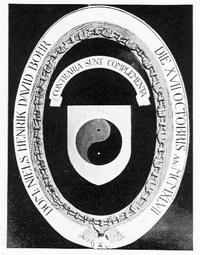
The heart of the play is the uncertainty in all knowledge of our selves and of history, and the complementarity of our differing interpretations. This uncertainty and this complementarity in human life are drawn as parallels to quantum physics. Bohr himself would doubtless have loved this: his writings take an expansive view of complementarity, applying it to such dichotomies as individuals versus community. This is a man who designed himself
a coat of arms with a yin-yang device and the inscription
CONTRARIA SUNT COMPLEMENTA.
( so what's my beef? )![[personal profile]](https://www.dreamwidth.org/img/silk/identity/user.png)