![[personal profile]](https://www.dreamwidth.org/img/silk/identity/user.png)


thinking about Copenhagen
Going in to a situation where quantum mechanics is going to be applied metaphorically is always like stepping under fire. I have friends who enjoyed Copenhagen, though, so I hoped to dodge the bullet.
I enjoyed it too. It centers on the 1941 visit of Werner Heisenberg, running Germany's nuclear program, to his mentor Neils Bohr in occupied Denmark: ranging forward to the U.S. bomb and the lack of a German bomb, and after the war to Heisenberg's tainted reputation, and backward to the time they had spent together, developing the Copenhagen interpretation. I learned quite a bit of history (and I hope most of it was true). The two of them doing physics together is great fun, and the sudden wartime end of their friendship is painful to watch. The play has them and Margrethe Bohr argue over that famously argued-over visit; it does a well-supported job of laying out each one's conflicting position, and then questioning all of them. In many ways I liked the play a lot, but I do have a problem (beyond silly stuff like getting the uncertainty relation backwards) with the physics.
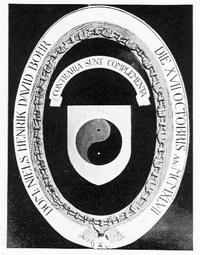
The heart of the play is the uncertainty in all knowledge of our selves and of history, and the complementarity of our differing interpretations. This uncertainty and this complementarity in human life are drawn as parallels to quantum physics. Bohr himself would doubtless have loved this: his writings take an expansive view of complementarity, applying it to such dichotomies as individuals versus community. This is a man who designed himself a coat of arms with a yin-yang device and the inscription CONTRARIA SUNT COMPLEMENTA.
The heart of the play, then, is the Copenhagen interpretation of quantum mechanics (which I'm going to start abbreviating "CI"). What nagged at me was this disparity: the play is multiple interpretations of self and past, but it treats as canon just one interpretation of QM. Meanwhile, hardly a physicist still living takes the CI seriously.
In this the play is in line with popular understanding of QM. Why is it that the CI has such appeal? (And why is many-worlds the only other popular contender?) I think it's precisely because the CI supports plays like this one, philosophies that appeal, and -- as Bohr says in the play -- the importance of human consciousness against an impersonal world. Many people love to explain how QM says that consciousness makes the world go 'round. The Copenhagen interpretation1 of QM is what says this, and it says it because the interpreter thought it should, and then because the physics, having nothing to say on the subject of consciousness, couldn't contradict him. I think it's the CI's appeal to our intuitions (and many-worlds', in an oddish way?) that makes it easy to believe. It's also true that for many years the CI was pretty much the only game in town, after von Neumann mistakenly suppressed hidden-variable theories and Bohr "brainwashed a whole generation of physicists into believing that the problem had been solved" (Gell-Mann, 1976). But not for a while now.
Granted, to inject modern understanding of physics into the play's reconstructed 1941 would be anachronistic, and into its detached afterlife framing would be tricky. More crucially, to smash its comfortable Copenhagen unity of theme and remake a larger whole would be quite beyond the play as written. So this is not a criticism of the play as poor, but more a pointer towards an imagined and extraordinary play. Maybe the downfall of the Copenhagen interpretation within physics is just too recent still for it to trickle down yet, and I can hope I'll get to see that play.
I enjoyed it too. It centers on the 1941 visit of Werner Heisenberg, running Germany's nuclear program, to his mentor Neils Bohr in occupied Denmark: ranging forward to the U.S. bomb and the lack of a German bomb, and after the war to Heisenberg's tainted reputation, and backward to the time they had spent together, developing the Copenhagen interpretation. I learned quite a bit of history (and I hope most of it was true). The two of them doing physics together is great fun, and the sudden wartime end of their friendship is painful to watch. The play has them and Margrethe Bohr argue over that famously argued-over visit; it does a well-supported job of laying out each one's conflicting position, and then questioning all of them. In many ways I liked the play a lot, but I do have a problem (beyond silly stuff like getting the uncertainty relation backwards) with the physics.
The heart of the play is the uncertainty in all knowledge of our selves and of history, and the complementarity of our differing interpretations. This uncertainty and this complementarity in human life are drawn as parallels to quantum physics. Bohr himself would doubtless have loved this: his writings take an expansive view of complementarity, applying it to such dichotomies as individuals versus community. This is a man who designed himself a coat of arms with a yin-yang device and the inscription CONTRARIA SUNT COMPLEMENTA.
The heart of the play, then, is the Copenhagen interpretation of quantum mechanics (which I'm going to start abbreviating "CI"). What nagged at me was this disparity: the play is multiple interpretations of self and past, but it treats as canon just one interpretation of QM. Meanwhile, hardly a physicist still living takes the CI seriously.
In this the play is in line with popular understanding of QM. Why is it that the CI has such appeal? (And why is many-worlds the only other popular contender?) I think it's precisely because the CI supports plays like this one, philosophies that appeal, and -- as Bohr says in the play -- the importance of human consciousness against an impersonal world. Many people love to explain how QM says that consciousness makes the world go 'round. The Copenhagen interpretation1 of QM is what says this, and it says it because the interpreter thought it should, and then because the physics, having nothing to say on the subject of consciousness, couldn't contradict him. I think it's the CI's appeal to our intuitions (and many-worlds', in an oddish way?) that makes it easy to believe. It's also true that for many years the CI was pretty much the only game in town, after von Neumann mistakenly suppressed hidden-variable theories and Bohr "brainwashed a whole generation of physicists into believing that the problem had been solved" (Gell-Mann, 1976). But not for a while now.
Granted, to inject modern understanding of physics into the play's reconstructed 1941 would be anachronistic, and into its detached afterlife framing would be tricky. More crucially, to smash its comfortable Copenhagen unity of theme and remake a larger whole would be quite beyond the play as written. So this is not a criticism of the play as poor, but more a pointer towards an imagined and extraordinary play. Maybe the downfall of the Copenhagen interpretation within physics is just too recent still for it to trickle down yet, and I can hope I'll get to see that play.
1 What exactly the One True CI is -- does it invoke consciousness? -- seems to be a matter of some disagreement. Some of this, appropriately here, is because various interpreters said various things at various times. A bare-bones interpretation of the Coperhagen interpretation says merely that some systems are quantum and some are not, and wavefunction collapse happens when a non-quantum system measures a quantum one. The line between quantum and non-quantum, where it is and what physics placed it there, is a separate question of interpretation. Heisenberg published a paper in 1960 suggesting that the line was thermodynamic irreversibility. Whether the idea that the line is consciousness predates Wigner in 1962, whether Bohr believed it, I don't know. Anyone? In any case, the consciousness interpretation of the CI is the interpretation that every non-physicist has heard of.